This kind of problem is fixable. The more people aware of food quality and the importance of small farms, the better. We go out of our way to buy good food from quality local farmers. ABN
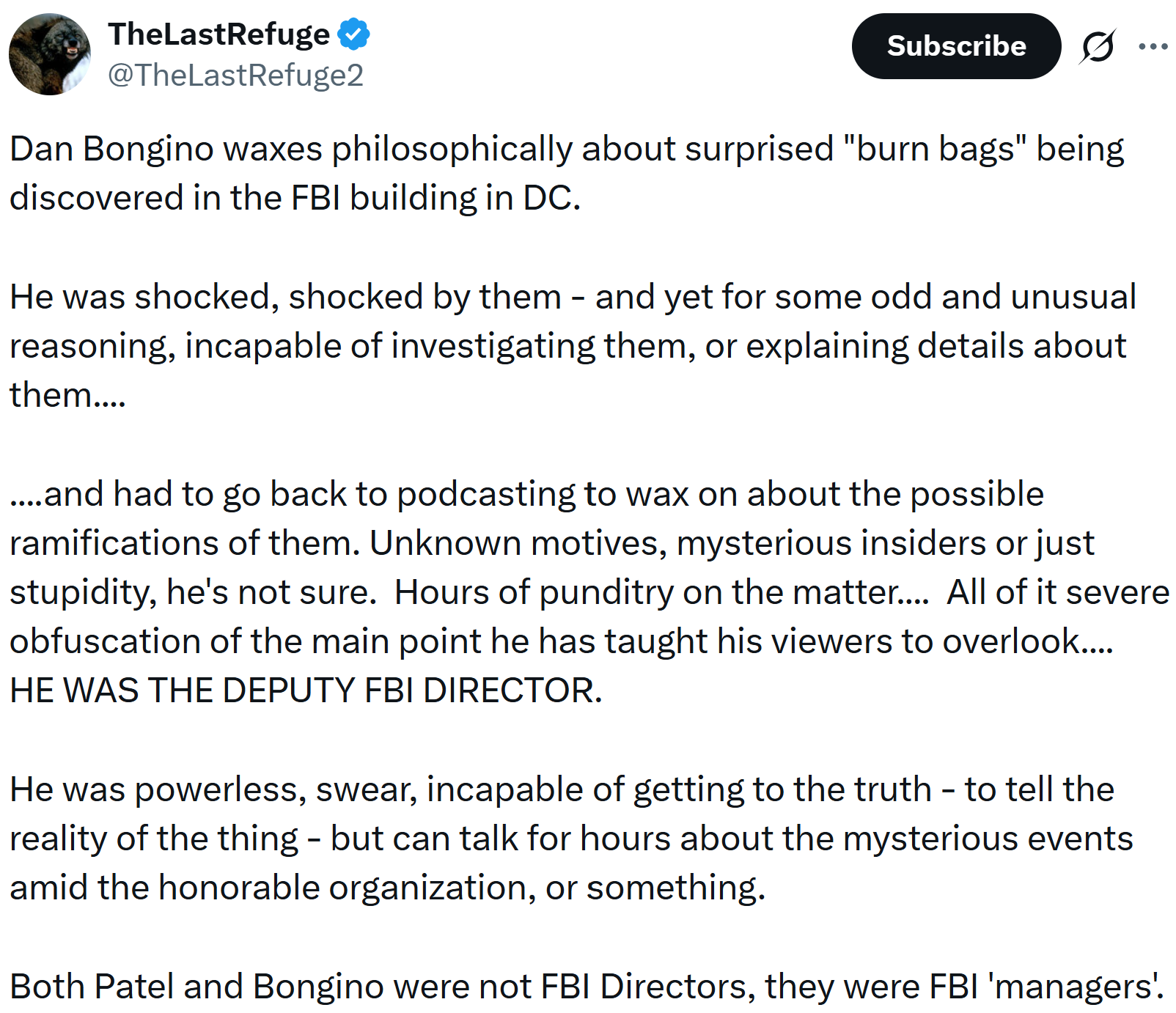
The FBI is doing corrupt, criminal and fraudulent stuff, and they are allied with the operatives in other agencies doing criminal, corrupt and fraudulent stuff.
Who determines the outcomes of Security Clearance reviews or investigations? Who is responsible for approving or denying security clearances?
She realized the problem.
You think the FBI wants honest elections?… That could result in larger ranks of honest, elected officials?… That hold oversight over them?
Do you really think valid and secure elections are in the interests of a corrupt FBI organization?
She found out. She was in the exact role to discover it.
Now you know why Tulsi was in Fulton County, GA.
And, more importantly, now you know why the SSCI was going bananas when they found out she was there.
Mark Warner wasn’t apoplectic the FBI was in Fulton County, Georgia taking control of election machines and ballots. He knew what the FBI was doing there.
Mark Warner was apoplectic because Tulsi Gabbard followed the FBI to Fulton County, to watch them take custody of the evidence with the intent to bury it.
The FBI was forced into action because@VoterGa was methodically winning the legal arguments.
I, for one, believe this is true. Not sure what people say today, but in the not-so-distant past many Chinese believed chicken causes cancer. Modern factory-bred and raised chickens live gruesome lives. For this and many other foods and products, farm-fresh and close to home quality produce is well-worth the extra money it costs. If it’s a good product from a good outfit, that’s the right thing to buy. Think of it as charity-spending if you like. Either that or try raising your own high-quality chickens (or anything else) and selling them; then you will see how much work it is. Farming and ranching are hard work and small producers who provide quality products should be supported by their communities. I hope in the future, assuming we have one, many more people will be able to make a good living providing high-quality foods and artisan products. Good food, reasonable exercise and sunlight are the keys to good health and a healthy mind. Being generous with local quality producers is key to getting more of them everywhere. Full disclosure: I do not own a farm but have worked extensively on one. ABN
My SO and I are doing some painting. Mostly it’s fun, but as we discuss colors and color combinations, it has become glaringly obvious that it can be extremely difficult to talk about what we want but easy to convey our ideas by showing an example of what we want.
I wanted to do something in brown. Words flew all over the room but got us no closer to mutual understanding, let alone agreement. We looked at color charts on the computer but couldn’t agree on what we meant by saturation, muted, lighter, or darker.
My SO, who is much better with color than I am, thought the meanings of those terms were obvious. “You’re overthinking this! You must know what lighter and darker mean!”
“Not when I consider luminescence or saturation, I don’t. I really don’t.”
Is a red-brown lighter or darker than a blue-brown? More or less saturated? I honestly was lost in the terminology and was driving my poor SO crazy.
After several days of this, at some point I noticed my wallet lying on the table. “This is what I mean,” I said. “I want a color like this.” The wallet was a well-worn, dark, leathery brown.
She immediately knew what I was talking about now. “What you want is a really dark brown… that’s almost a black.”
Excited, we went back to the color chart (which has 3,500 color variations) and looked into a different classification of browns. Low and behold, the darkest one available—Tarpley Brown—is exactly what I wanted.
So, I had something in my mind’s eye but failed repeatedly to convey it to my SO through the use of language. She tried to figure out what I meant but kept searching for a more woody sort of brown while becoming increasingly confused by my groping attempts at description.
From this, we can see how difficult it is to understand other people or even ourselves. Many important aspects of being human simply do not have clear examples in the world around us and are much more difficult to put into words than a color.
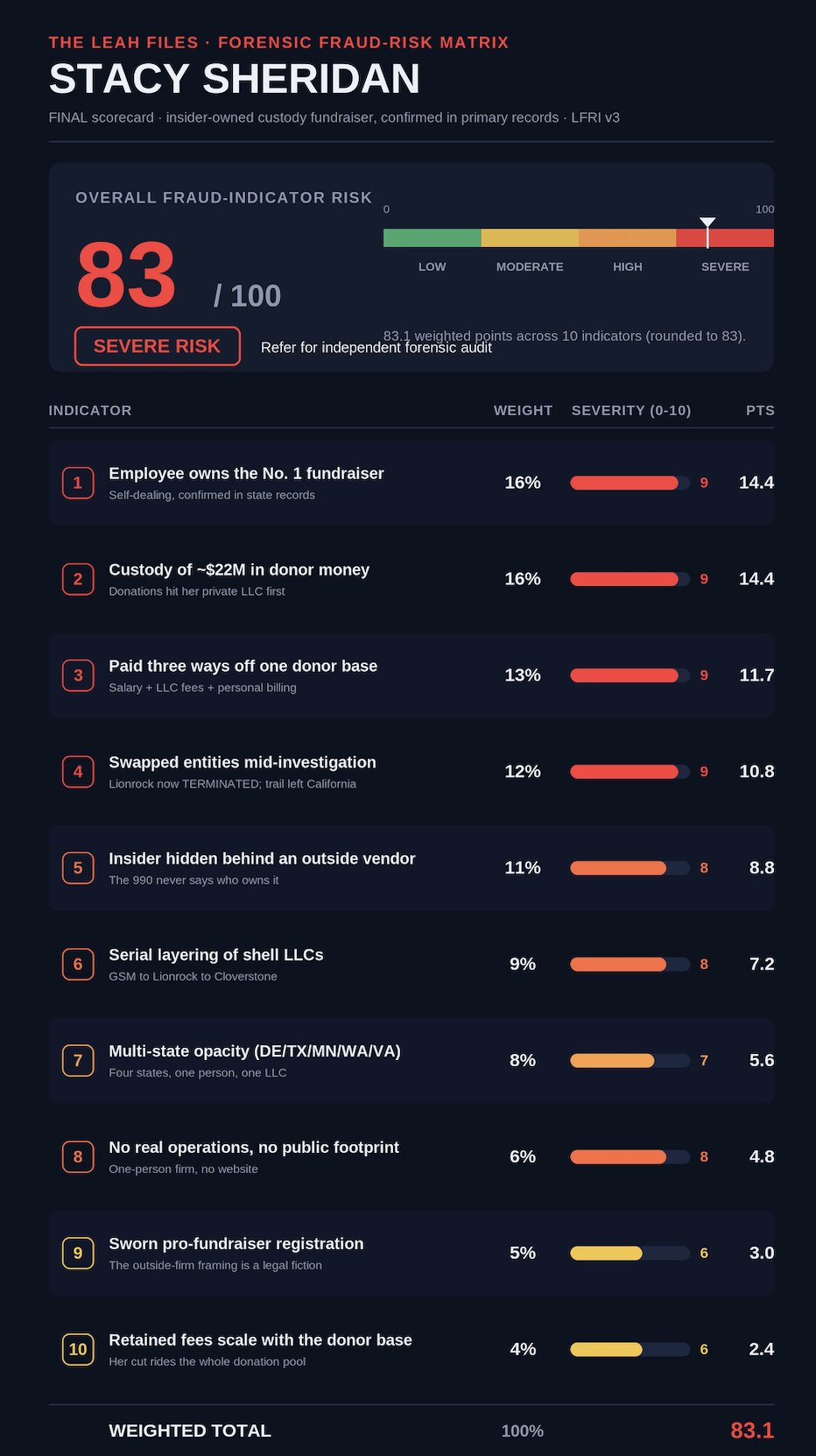
Stacy Sheridan is TPUSA’s inside fundraising boss AND she owns the outside firm the charity pays to raise its money. She sits on both sides of the same check. More than $88 million in donations has run through her hands, and her private companies quietly kept ~$5+ million of it. She is the highest-scoring name in this series so far.
Who is Sheridan?
Stacy Sheridan spent two decades as a professional fundraiser at Pepperdine, the Reagan Foundation, and the Gary Sinise Foundation. Turning Point then hired her as its Senior Advancement Director on a salary north of $180,000. Her job was to raise the charity’s money. So she did, into companies she owns.
Three of them, GSM Strategy, then Lionrock Ventures, then Cloverstone Ventures. Each one billed the charity she already worked for. Each one traced back to her only through another state’s corporate records and her own home address, never as the owner of those companies on the tax return itself. As each drew scrutiny, it went dark and the next one appeared. She turned a nonprofit’s donor base into a private revenue stream, made herself almost invisible on paper, and made herself indispensable in person.
Today she sits at the right hand of TPUSA’s new CEO, Erika Kirk, closer to the money than she has ever been.
What she is doing: the four signatures of an inside job
This looks like an insider-controlled fundraiser, a specific and well-documented form of self-dealing. It has four signatures, and Sheridan hits all four.
1. Same hand on both sides: the employee who helps decide who gets hired to raise the money owns the firm that gets hired to raise it. She is the buyer and the seller of the same service, sitting on both sides of a table with no one across from her.
2. Custody and control: she does not just get paid, she holds the donations. The money lands in her company’s account first, and she is the one who counts it and reports the number to the IRS and to the people who gave it. The insider who profits is also the one keeping the books.
3. The relay: not one company. Three, in a chain. Each terminated or gone dark the moment it drew a reporter, each reborn in a more sheltered state than the last. The entities keep changing names but the owner never changes.
4. Concealment: the return never says she owns the firm it pays. You only learn that in another state’s records. In Minnesota, Cloverstone, whose sole officer is Sheridan, registered under oath as an independent outside professional fundraiser. Based on the record, it is not.



 American Buddhist Net